Showing posts with label Bedfordshire Local History Association. Show all posts

Monday, 17 June 2013

Bedfordshire Local History Association Summer Meeting 2013

Forty-six local historians from twelve local history societies around the county assembled at Maulden Village Hall on Saturday 15 June 2013 for the Association’s AGM and a day of lectures and a visit on the topic of “Bedfordshire Railways”.
David Thomas gave a very interesting illustrated talk focussing on the Bedfordshire branch of the Oxford to Cambridge Line.  This began in the county with the London & North Western Railway line’s first stretch being built here from Bedford to Bletchley (still in operation) in 1846.  In 1851 the Bletchley to Oxford extension was built, and finally, in 1861-2, the Bedford to Cambridge extension.  The Oxbridge line’s main stations in Bedfordshire were at Ridgmont, Lidlington, Marston, Bedford, Blunham, Sandy and Potton with additional small halts, bringing the number of stops to 15 within the county.
Because of the importance of the universities at Oxford and Cambridge, this cross-country line was sometimes known as the “Varsity Line” and its trains “brain trains”.  It had connections with six main lines heading north, west and east from London and therefore gave great flexibility to passengers from Bedfordshire who could travel around the country, by changing at points on the line to other railway companies’ services, without having to go into London first (as is the case today!).
Unfortunately, following Dr Beeching’s rationalisation and drastic reduction in the railway system from 1967 onwards, the Bedford to Cambridge line was closed, with the Bedford to Cambridge lines lifted, leaving only a service from Bedford to Bletchley, meeting up with the London Midland Region main lines from London to the Midlands and the North West.
David Thomas then traced the more recent developments, including the closure of the old St John’s Station in Bedford, with the line being diverted to Bedford Midland Station in 1984 (with a later, new, halt at Bedford St John) and the overall modernisation of signalling and level crossings along the Bedford Bletchley line in 2004.  Earlier, in 1961, Marston saw the installation of the second-only automatic continental level crossing barriers in the country.  Warning signs, unusually, were in both English and Italian, as there were so many Italian-speaking workers at the local brick works!  Recently, it has been confirmed that there are firm plans to reinstate the Bedford to Oxford railway service in the near future.
The second speaker in the morning was Nigel Lutt from the county record office (BLARS) who gave a very informative illustrated talk outlining just some of the many archive sources for material on railway history in Bedfordshire, not all of them in documents where you would expect to find them.
Attendees to the conference were then treated to a very tasty hot lunch, after which they were able to view the range of interesting displays in the hall relating to railway topics, with displays from the ADALHS regarding temporary railways in Maulden Woods (operated by the Canadian Foresters during WWI), Warren Wood and Wrest Park.  Fergus Milne brought along examples of his railway art and there was an extensive display from BLARS.
For the afternoon session, members moved by cars to Millbrook where David Thomas, who lives in the Station House there, showed his collection of railway memorabilia.
Although less ambitious in its scope and number of speakers than in previous years (& consequently less well attended than, say, 2012, when there were 91 attendees from some 20 Beds societies) the BLHA committee is to be congratulated on putting it on and thanks given to the new Millbrook History Society for organising it.  The annual event is an almost unique opportunity for local historians to get together and catch up with each other’s researches, activities and publications.  BLHA’s own umbrella website is an excellent, one-stop source of contacts for all the many local history societies in Bedfordshire, with links to their websites and, in many cases therefore, to their programme of talks and visits.
BLHA is looking urgently for volunteer societies from its membership to take on responsibility for arranging a conference for 2014 (and also for 2015).  Societies which have not yet taken this on, perhaps finding the thought rather daunting, can receive much help from those other societies which have organised conferences in previous years.  
To discuss conference possibilities for future years, contact Clive Makin, BLHA Secretary, at 01582 655785 or via email  :
For information on Bedfordshire railway history, see F.G. Cockman The Railway Age in Bedfordshire (Revised edition 1994)
Written by Stuart Antrobus

Sunday, 17 June 2012

Bedfordshire Local History Association Conference: 9 June 2012


The annual get-together of Bedfordshire local historians took place on Saturday 9 June under the auspices of the umbrella organisation for local history societies in the county, Bedfordshire Local History Association.  It was hosted this year by Ampthill &District Archaeological and Local History Society and held in the Learning Zone at Poplars Garden Centre, Toddington. Over 90 people attended, representing some 20 local history organisations, as well as individuals.
They were treated to a diverse range of talks on topics including the fire at Wrest Park in 1916, “The Lost Hamlet of Wadelow”, “Art Deco Buildings in Luton” and the medieval wall paintingsat Chalgrave Church.  Martin Deacon brought us up-to-date with what Bedfordshire Archives has to offer and on the Centenary celebrations planned for 2013 by what was the first County Record Office in the country, established in 1913 by Dr.George Herbert Fowler, its first archivist.
Ruins of Houghton House near Ampthill, built in 1621
For me, the highlight was the illustrated talk on “Lost Houses of Bedfordshire” by leading Bedfordshire historian, Simon Houfe.  Not only did he show us pictures of some of these houses and tell us about the families who built them but analysed the various reasons which led to their demise.  In 1765 there were 60 substantial country houses in Bedfordshire; by the 1960s there were only 6 which had been built in the 18th century.  Reasons why they failed to survive ranged from decline in the income from the land around them on which they mainly relied, the vagaries of inheritance whereby they sometimes ended up in the hands of someone who preferred living elsewhere in the country, to the tremendous impact of the Great War of 1914-18 which led to the death of sons and heirs.  It was usually a case of the survival of the fittest. Death duties were the final blow to many.
Eggington House photographed about 1900
BLHA President, Martin Lawrence, summed up the conference and reminded us of various significant anniversaries being celebrated this year, especially the centenary of the setting up of our own Bedfordshire Historical Record Society, in 1912, again by Dr Fowler and others.
The annual BHLA conferences are always worth attending for the opportunity to meet like-minded local historians from around the county, most of whom one only sees once a year at this event.  It also reminds us of the great interest there is in the county in its history and of the contribution which local history societies can make in researching, publishing and enthusing to others about their unique locality.
This year, in addition to the presentations, it was worth attending, if for nothing else – and the food was very good! – for the opportunity, as a group, to visit Chalgrave Church [Grade 1 listed building, built c1300] and view the outstanding medieval wall paintings it contains which make this a real gem in the county.

Stuart Antrobus
Bedford Architectural, Archaeological and Local History Society.

Sunday, 6 June 2010

Bedfordshire Local History Association Conference 2010

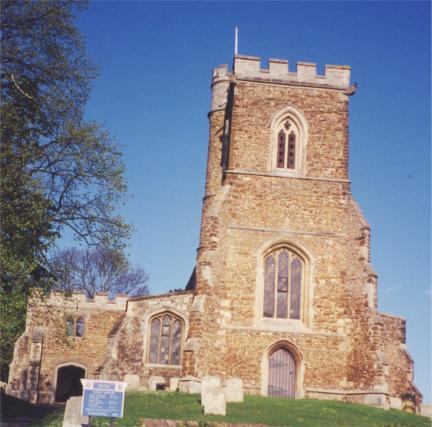
Potton History Society hosted the annual AGM and conference, this year, at the lovely St Mary’s Church and church hall situated on the Gamlingay side of the ancient market town. The sun shone on the 53 members from some of the 31 member societies as well as a major team of local society members working hard to make the day work smoothly. Chairman George Howe gave us all a warm welcome.

Peter Ibbett, Programme Secretary and a founder member of this leading local group (founded 1977), gave an inspirational opening presentation on ‘The Challenge to 21st Century Local Historians’, looking back to those pioneers such as Betty Chambers, editing the Bedfordshire Magazine, after the Second World War and the growth of local history societies which began in the 1970s in particular. He emphasised that it was people and their sense of local affinity which motivated much of the diverse research into local history. He reminded us how much photographs from the past provoked local interest and that personal connections were so important. Local documents enabled us to ‘time travel’ and the exhibitions of these photos and documents inspired others to get involved in researching local history.


Now, in a multi-digital era, the problem was often ‘seeing the wood for the trees’ and this was where local history groups could play their part. In a question and answer session with the Potton Society’s web master, Sean Hendry told of how he got involved in setting up and developing their web site into one with15 separate parts and a monthly update of material to be found in the ‘What’s New’ section, drawing people from around the county, the country and even internationally into revisiting the site. Content included a virtual tour of Potton and information on upcoming talks arranged by the Society as well as an extensive photographic archive (from over 7,000, all have also been digitised!) and write-ups on members’ research into a wide variety of topics.

A lively discussion took place among those attending as to how to maximise effectiveness of local history archives and web site. This was followed by an opportunity to view a sample of the range of hard-copy material the Society had produced over the last few decades, with documents and photographs carefully indexed so as to make access to related material easy.

Those who were most active and mobile were taken by Peter on a walking tour into and around the market square of the town where developments over the century, particularly the rise and fall of the market, and key people and buildings were highlighted. Others chose to stay in and around the ironstone church and its graveyard, both of which were full of interest.


All then met up for a delicious buffet lunch, provided by local people, in the well-appointed church hall, where the rest of the conference took place.

Pamela Birch of the County Record Office (BLARS: Bedfordshire and Luton Archives and Records Service, to give it its full name) discussed the county’s web scene as it related to local history. The key web sites shown or mentioned were those of BLARS (including its online public access catalogue:OPAC), Bedford Museum, Luton Museum and Bedfordshire Libraries. Local history society web sites also played their part. The OPAC catalogue currently gave references to 60% of the county archive’s holdings. Their Community Archives pages had started as resources for school but had developed into ones for adults as well, with the ambitious aim of covering every settlement in the historic Bedfordshire (including Luton), offering material on the local church, non-conformist chapels, education, interesting buildings, licensed premises and a general introduction, showing current photographs as well as related references. 69 communities, over the three local authorities, had so far been covered and completion planned by 2023.


She also outlined another long-term project to transcribe the registers for Bedford County Gaol from 1801 onwards, with 30,000 entries currently on the web site. There were also plans for digitisation of such things as the 1925 rate evaluation maps but this was expensive and hard to get grants for. They were putting the Sandy Chrystal postcard collection online as it is being catalogued. School registers 1870 – 1914 were also a priority and BLARS hoped to apply for funding within a consortium bid from a number of record offices nationally.

The problems of copyright were touched on as well as the need for the record office to derive income from copies of documents and photos, in the same way that libraries relied on fines and museums relied on shops or catering for income generation.


Pamela outlined how societies and individual volunteers could help the archives with their work by: supporting their application for grants, volunteering a day a week, helping with research and telling other people about the resources and services which BLARS offers. Pamela announced that BLARS was now accepting their first deposits of digital oral history sound recordings, bringing them in line with other record offices.

After a discussion on how the BLHA might co-ordinate or encourage local history web activity, George Howe and Peter Ibbett shared a ‘two Ronnies’ audio-visual presentation on local people and places, ‘They Walked Potton Streets’, which was lively, informative and entertaining.

The atmosphere of the day was friendly, welcoming, inclusive and altogether uplifting. The friendly folk of Potton were mostly to thank for that but the sun and the glorious setting did help.


Stuart Antrobus